PhD Thesis - Abstract
The doctoral thesis presents an algorithm for distributed generation short-term planning aimed at reducing the active power technical losses in the distribution network. The proposed algorithm consists of three parts: prediction of solar power plants energy production, optimal operation planning of multiple hybrid distributed generation units, and evaluation of optimization results. Prediction of solar power plants energy production is achieved by modelling multilayer artificial neural network capable of providing the information on expected solar power generation based on input data on air temperature, solar irradiation, relative air humidity, and wind speed. Optimal operation planning of distributed generation is the most complex part of the proposed algorithm because it implies a unique hybrid optimization method based on particle swarm optimization with respect to the elitism principle of the genetic algorithm. The MATPOWER simulation package, which is used for test power systems modelling, power flow calculations, and the technical determination of distributed generation according to the particle parameters, has been hybridized within the optimization method. Evaluation of optimal solutions is a third part of the proposed algorithm, achieved by fuzzy logic system, which provides the evaluation of cost efficiency for the planned operation of distributed generation with respect to savings achieved by active power losses reduction. The proposed short-term planning algorithm has been successfully applied in the optimization and planning of distributed generation in three test power systems, and full applicability is proved by a high level of optimization efficiency of active radial and meshed power networks.
Reserach interests

Distributed Generation
- Planning
- Scheduling
- Optimization
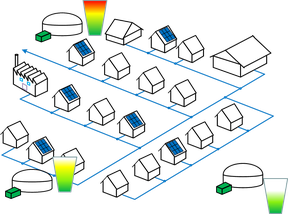
Smart-Grid
- Operation
- Optimization
- Protection & Control

Artificial Intelligence
- Application to Power Engineering
- Hybridization
- Co-simulation
Selected papers - abstracts
Glavaš, Hrvoje; Vukobratović, Marko; Keser, Tomislav.
Infrared thermography as control of handheld IPL device for home-use
Infrared thermography as contactless method for determining the temperature distribution on the surface is used for analyzing the impact of intense pulsed light hair removal device (IPL) on the skin. Depth of light penetration depending of wavelength is described as well as absorption curves and IPL impulse shapes. Energy balance and IPL impulse influence on the skin is analyzed. Melanin temperature rise by different fluence operation and temperature distribution in the modeled hair is used in order to determine overall skin temperature rise. Estimated energy balance provided by mathematical model has been confirmed with experimental results. Performed measurements, beside determination of the right emissivity, required the identification of most significant parameter in the process which proved to be the skin reference temperature and real temperature rise. Practical IPL application with detailed body temperature analysis is comprehensively described and thermal imaging interpretation problem and determination of the temperature rise is observed.
Šerman, Bojan; Glavaš, Hrvoje; Vukobratović, Marko; Kraus, Zorislav.
TELOS Feasibility Analysis of Photovoltaic Power Plant
Energy independence as the goal of EU energy policy encourages energy efficiency measures and renewable energy sources (RES) implementation. Photovoltaic (PV) plants represent the usual technical solution when reconstructing/maintaining a roof or as an investment that is expected to result with a material gain. The viability of the investment is unquestionable, but when the means of implementation are provided by an external institution, a cost-effectiveness analysis is necessary. When a financial institution has no experience with similar projects, the complete TELOS analysis is required. This paper provides a complete TELOS analysis (Technology Feasibility, Economic, Legal, Operational and Schedule Feasibility) of the PV power plant implementation.
Nikolovski, Srete; Vukobratović, Marko; Majdandžić, Ljubomir.
Protection Coordination and Anti Islanding Protection Solution for Biomass Power Plant Connected on Distribution Network
Protection coordination as well as anti-island protection play significant role in the process of biomass power plant connection on the distribution network. Distribution generation island operation in Croatia is unacceptable according to the existing National grid code Paper presents a protection coordination of all passive protections used in the real biomass power plant and connected distriubution network feeder. Short-circuits three phase, two phase and single line to ground faults and generator islanding simulations have been performed and simulated in the time domain at the different network locations using DIgSILENT Power Factory software. The time-current plots coordination of protective devices are made using Smart PDC module in Easy Power Protector software tool.
Vukobratović, Marko; Marić, Predrag; Hederić, Željko.
Voltage and power losses control using distributed generation and computational intelligence
The paper analyzes the possibility of reducing active power losses in power system, constrained by regulated voltage levels, by implementing appropriate distributed generation capacity. The objectives of this paper were achieved by developing hybrid methods based on artificial neural network and genetic algorithm. Methods have been developed to determine the impact of different distributed generation power on all terminals in the observed system. The method that uses artificial neural network and genetic algorithm is applicable for radial distribution networks, and method using load flow and genetic algorithm is applicable to doubly-fed distribution network. For comparison purposes, additional method was developed that uses neural networks for the decision-making process. Data for training the neural network was obtained by power flow calculation in the DIgSILENT PowerFactory software on a part of Croatian distribution network. The same software was used as an analytical tool for checking the correctness of solutions obtained by optimization.
Vukobratović, Marko; Nikolovski, Srete; Marić, Predrag.
Improving the Conditions in a Radial Distribution Feeder by Implementing Distributed Generation.
Distribution feeder is the final stage in the delivery of electricity to consumers. The feeder can be radial or networked. Radial feeders leave the power station towards the consumers without any connection to other power supply. Networked feeders have multiple connections to other supply points. It is common for long radial feeders for voltage to drop along the way and for losses to increase with increasing consumer’s power or the number of consumers. In order to minimize feeder losses and improve voltage profile distributed generation (DG) can be implemented. It is important to define the optimal location and power of distributed generation in a specific feeder to obtain its maximum potential benefits. This paper presents a solution for optimal DG placement by selecting the right terminal and power of DG using the Genetic Algorithm (GA) and the Artificial Neural Network (ANN) hybrid method. The method is tested on a part of Croatian distribution network and verified by DIgSILENT PowerFactory software and the analytical approach. The results and comparison thereof and presented in clear and legible form.